
Description
DEIF
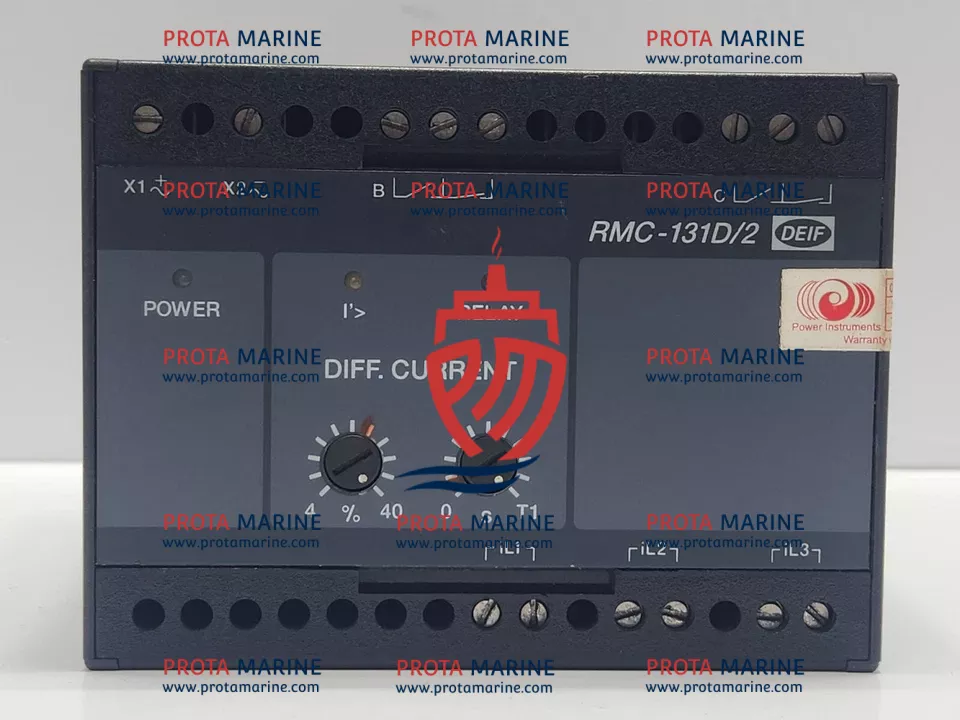
RMC-131D/2
DIFFERENTIAL CURRENT RELAY
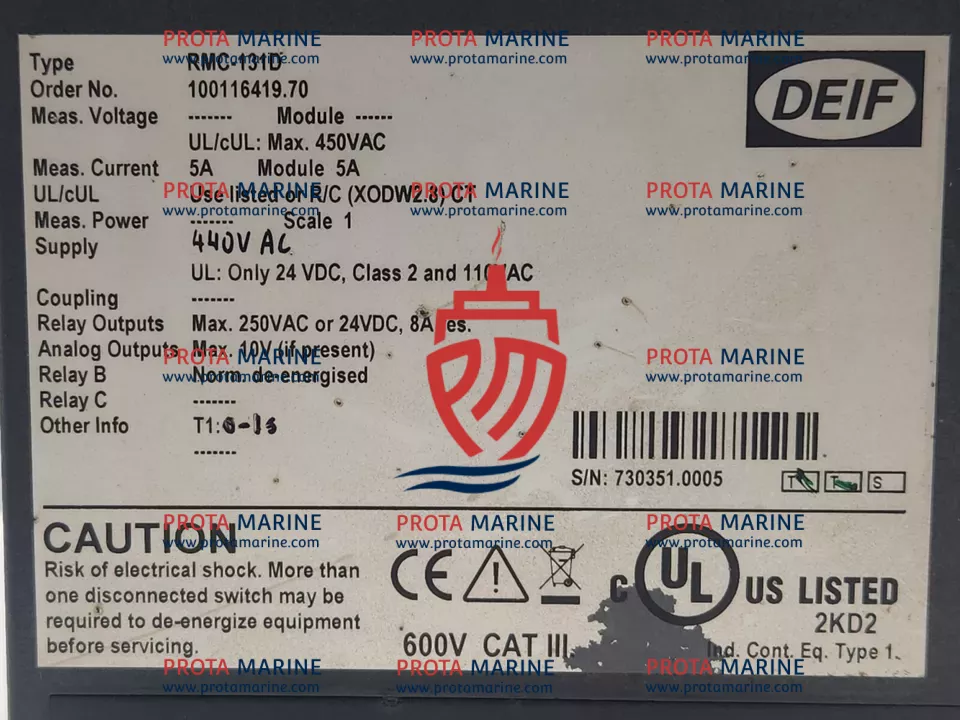
TYPE: RMC-131D
ORDER NO: 100116419.70
MEAS. VOLTAGE: …..MODULE…..
UL/CUL: MAX.450VAC
MEAS. CURRENT 5A MODULE 5A
MEAS. POWER: ….. SCALE 1
SUPPLY: 440VAC
UL: ONLY 24 VDC, CLASS 2 AND 110 VAC
RELAY OUTPUTS: MAX. 250VAC OR 24VDC, 8A RES.
ANALOG OUTPUTS: MAX. 10V (IF PRESENT)
600V CAT III
The DEIF RMC-131D/2 is a differential current relay designed to detect imbalances between measured current inputs, triggering protective relay outputs when a fault condition is identified. Rated at 600V CAT III and supplied at 440VAC, this relay module is built for the demanding electrical environments found aboard commercial and industrial vessels. As a core component within marine control systems, it plays a critical role in protecting generators, switchboards, and distribution equipment from differential fault conditions that could otherwise result in equipment damage or loss of power availability at sea.
Key Features
✓ Differential current sensing with a 5A measurement current module, providing reliable fault detection across protected circuits.
✓ Supply voltage of 440VAC with UL/CUL rating up to max. 450VAC; UL-listed configurations also support 24VDC Class 2 and 110VAC supply options.
✓ Relay outputs rated at max. 250VAC or 24VDC, 8A resistive, enabling direct integration with alarm, shutdown, or control circuits; analog output up to max. 10V where the analog output option is fitted.
✓ Rated 600V CAT III, confirming suitability for installation within switchboard panels and power distribution environments subject to transient overvoltage conditions typical in marine electrical systems.
✓ Modular DEIF RMC-series architecture allows for straightforward replacement within existing DEIF control and protection panel assemblies, subject to confirmation of system compatibility and configuration.
Marine Applications
✓ Main and auxiliary switchboard protection on merchant vessels, tankers, bulk carriers, and offshore support vessels where differential current monitoring is required.
✓ Generator protection systems aboard passenger ferries, RoRo vessels, and container ships where continuous power availability is operationally critical.
✓ Power management and distribution control panels in vessels operating DEIF-based automation and protection architectures.
✓ Electrical fault protection within engine room control systems on offshore platforms, OSVs, and anchor handling vessels subject to high electrical load variation.
✓ Retrofit and upgrade applications where ageing differential protection relays within existing DEIF panel assemblies require like-for-like replacement to maintain system integrity.
Why Marine Engineers Choose
The DEIF RMC-131D/2 is a well-regarded differential current relay within the marine control system sector, valued for its clearly defined electrical ratings, modular design, and compatibility with DEIF’s established range of protection and power management equipment. Its robust 600V CAT III rating and versatile output configuration make it a dependable choice for shipboard electrical protection applications where reliability and traceability of specifications are essential.
Ideal For
Merchant vessels, tankers, bulk carriers, container ships, passenger ferries, offshore support vessels, platform supply vessels, anchor handling tugs, and any vessel operating DEIF-based marine control and power management systems requiring differential current protection.
Technical Support & Compliance
Technical assistance is available to support remote troubleshooting, onboard diagnostics, testing and commissioning, and integration of this relay within existing marine control system architectures. Retrofit and upgrade support can also be provided where panel drawings or system documentation are available. To confirm compatibility and suitability for your specific installation — subject to confirmation — buyers are advised to share nameplate photographs, the full order number, panel or system drawings, the DEIF system model and software version where applicable, and vessel name or IMO number. This allows accurate cross-referencing prior to order and helps ensure the correct module configuration is supplied for your application.